
N.A.T.U.R.E FRAME WORK
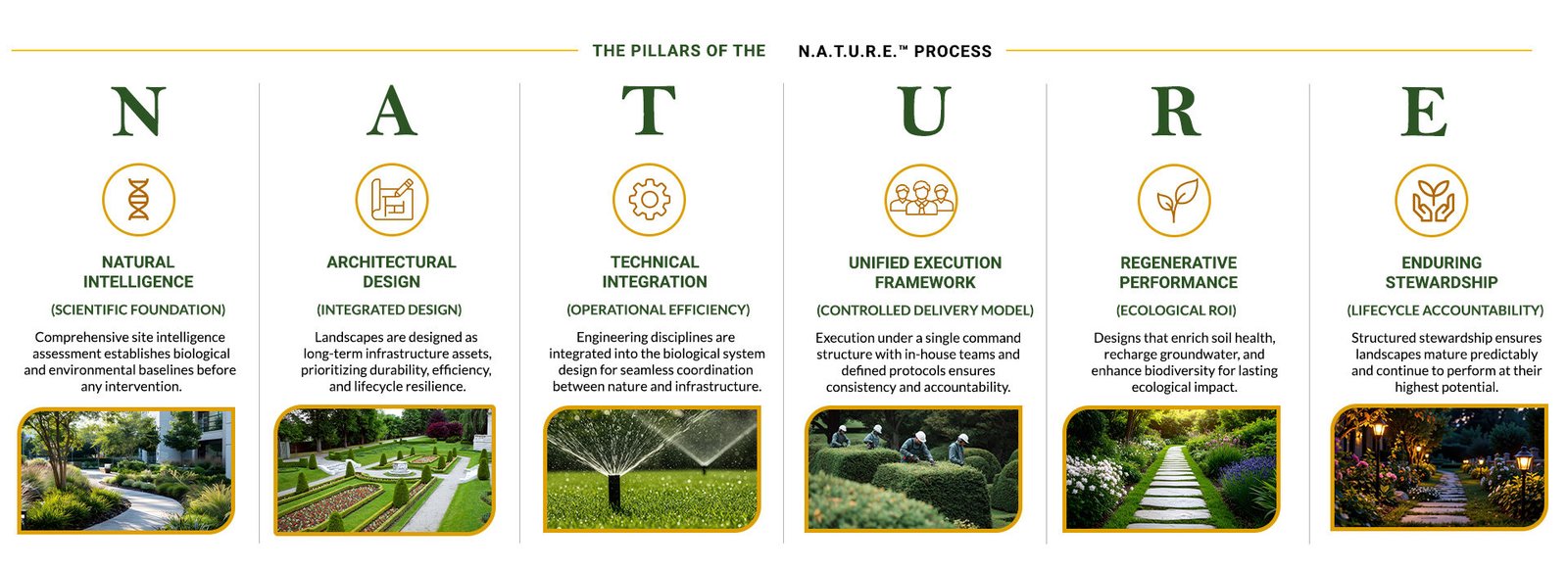
N.A.T.U.R.E Framework
Six-Pillar Landscape Excellence
Nature Framework at VBR Landscaping is a structured, data-driven approach that delivers sustainable, aesthetic, and high-performance outdoor designs. This proprietary methodology replaces conventional planting-and-maintenance practices with a system-led, performance-oriented delivery model.
Consequently, this framework ensures that every project—whether corporate campuses, urban infrastructure, hospitality, or premium developments—is executed with precision, scientific validation, and lifecycle accountability.
Nature Framework – Pillars
N — Natural Intelligence {Scientific Foundation}
Every project begins with a comprehensive site intelligence assessment to establish biological and environmental baselines before any physical intervention.
Scope Includes:
- Soil profiling and fertility diagnostics
- Hydrological behavior and drainage mapping
- Micro-climate and exposure analysis
- Site constraints and risk identification
Outcome:
Data-driven inputs that guide design decisions, reduce uncertainty, and minimize risks.
A — Architectural Design {Integrated Design}
Landscapes are designed as long-term infrastructure assets, prioritizing durability, efficiency, and lifecycle performance over short-term aesthetics.
Design Priorities:
- Structural stability and constructability
- Water efficiency and soil longevity
- Compatibility with built infrastructure
- Lifecycle cost optimization
Outcome:
Sustainable landscapes with long-term functional performance and asset value.
T — Technical Integration {Operational Efficiency}
Engineering systems are integrated into the biological design to ensure seamless coordination between nature and infrastructure.
Key Integrations:
- Automated irrigation systems
- Engineered drainage and sub-soil layers
- Soil and root-zone engineering
- Integration with civil and architectural works
Outcome:
High-performance systems ensuring long-term resilience and efficiency.
U — Unified Execution Framework {Controlled Delivery Model}
Execution is managed under a single operational structure, eliminating reliance on fragmented vendors.
Execution Controls:
- In-house civil and horticulture teams
- Proprietary plant sourcing and logistics
- Defined installation protocols
- Continuous quality monitoring
Outcome:
Consistent execution with strong quality control and accountability.
R — Regenerative Performance {Ecological ROI}
Landscapes are designed to improve soil health, groundwater recharge, and biodiversity over time.
Engineering Focus:
- Climate-resilient species
- Efficient soil and water systems
- VBR ECO-MATRIX™ protocols
- Long-term ecological planning
Outcome:
Stable ecosystems with reduced maintenance risk and improved performance.
E — Enduring Stewardship {Lifecycle Accountability}
Responsibility extends beyond execution through structured maintenance and performance monitoring.
Stewardship Includes:
- Establishment and growth planning
- Soil and plant health audits
- Preventive maintenance systems
- Ongoing performance optimization
Outcome:
Landscapes that mature predictably and retain long-term value.
The Result
A high-performance, self-regulating landscape ecosystem designed for reliability, ecological stability, and sustained value—delivered with the precision and discipline of modern infrastructure systems.