
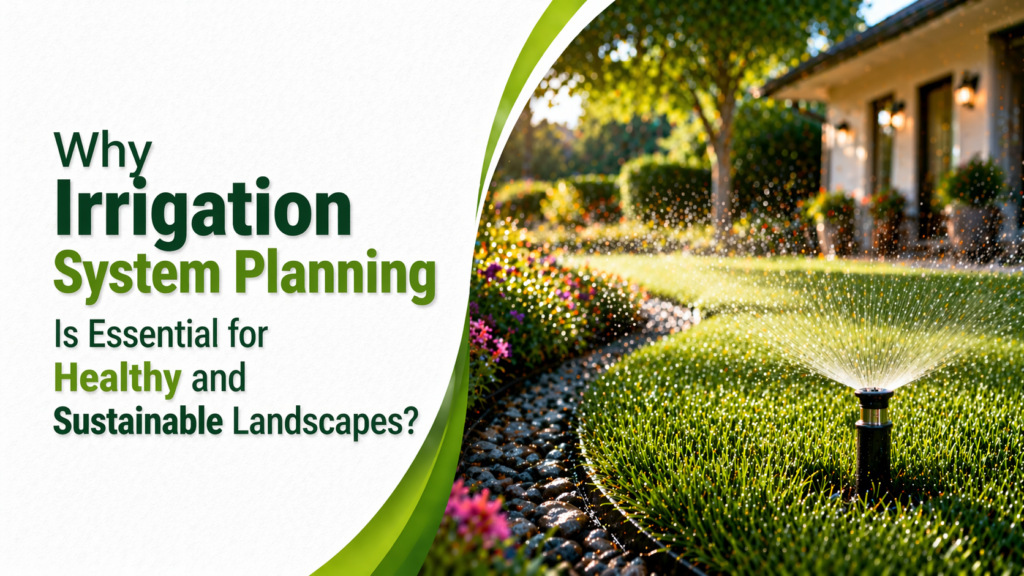
A lush, thriving landscape does not happen by chance. Behind every green lawn and vibrant flower bed is a well-thought-out watering strategy.
Irrigation system planning is the foundation of that strategy — a process that ensures every plant, tree, and grass patch receives exactly the water it needs, exactly when it needs it.
Poor watering habits lead to plant stress, soil erosion, runoff, and wasted resources. A well-designed system, supports long-term landscape health while contributing to water-efficient landscaping practices that benefit both the environment and your wallet.
This guide covers everything you need to know about irrigation design. You will learn the key components of sprinkler systems and what professional irrigation installation involves.
We also explain how smart landscape water management keeps your outdoor spaces thriving long-term.
What Is Irrigation System Planning?
Irrigation system planning is the process of designing a structured watering network for a landscape before any physical work begins. It involves assessing your property’s water needs, analyzing soil type and drainage patterns, mapping out plant zones, and selecting the right irrigation equipment to deliver optimal coverage.
This planning phase is not a formality — it is a critical step that determines how efficient, effective, and cost-saving your entire irrigation setup will be. Skipping it or rushing through it often results in uneven watering, over-irrigation, under-irrigation, and expensive retrofits down the line.
A thorough plan considers several factors:
- Total area of the landscape and its layout
- Type and water requirements of plants in each zone
- Local climate conditions and seasonal rainfall averages
- Soil composition and absorption rate
- Available water pressure and flow rate
- Budget constraints and long-term maintenance goals
When all these variables are addressed before irrigation installation begins, the resulting system performs with greater precision and reliability.
Why Proper Planning Is Not Optional
Many homeowners and property managers view irrigation as a straightforward task — lay some pipes, install a few heads, set a timer, and you are done. However, this approach almost always leads to inefficient watering, patchy growth, and unnecessary water waste.
Here is why proper irrigation system planning is absolutely essential:
1. It Prevents Water Waste
Unplanned systems frequently result in overwatering, where runoff carries water — and valuable nutrients — away from plants entirely. According to the U.S. Environmental Protection Agency, landscape irrigation accounts for nearly one-third of all residential water use, and up to 50% of that is wasted due to inefficient methods. A well-planned system reduces this waste dramatically through precise zone targeting and timed delivery.
2. It Supports Plant Health
Different plants have vastly different water requirements. Grouping plants with similar hydration needs into separate irrigation zones — a practice known as hydrozoning — ensures that no plant receives too much or too little water. Without this planning step, one part of your garden may thrive while another slowly deteriorates.
3. It Saves Money Over Time
A thoughtfully planned system reduces water consumption, which directly lowers your utility bills. While the upfront investment in quality irrigation installation might seem significant, the savings on monthly water costs — combined with reduced plant replacement costs — make it highly cost-effective in the long run.
4. It Protects Soil Structure
Overwatering or poorly directed water flow can lead to compacted soil, root rot, and nutrient leaching. Proper planning accounts for soil drainage and adjusts watering schedules accordingly, preserving the structure and fertility of your soil for years to come.
5. It Enables Automation and Smart Management
A well-planned irrigation system can be fully integrated with smart controllers that use real-time weather data to adjust watering schedules automatically. This advancement in landscape water management technology means your system waters only when necessary, adapting to rain, humidity, and seasonal temperature changes without any manual intervention.
Key Elements of a Successful Irrigation System Plan
A comprehensive plan covers both the technical and environmental aspects of your landscape. Let us break down the core components:
Site Analysis
Before selecting any equipment, a thorough site analysis is essential. This involves measuring the dimensions of your property, identifying slopes and shaded areas, testing soil permeability, and noting existing plantings. Understanding these physical characteristics ensures the irrigation design aligns with the actual conditions on the ground rather than assumptions.
Water Source Assessment
The water source — whether municipal supply, well water, or harvested rainwater — determines your system’s pressure and flow capacity. Matching your equipment to your available water pressure ensures that sprinkler systems deliver consistent coverage without underperforming or causing pipe strain.
Zoning Strategy
Dividing your landscape into distinct irrigation zones—based on plant type, sun exposure, and soil conditions—is one of the most effective strategies in irrigation system planning. For instance, lawns, shrub beds, vegetable gardens, and trees each have unique water requirements. However, when these areas are treated as a single uniform zone, it often results in improper water distribution. As a result, some plants may become overwatered while others remain undernourished, leading to overall imbalance in the landscape.
Equipment Selection
The right tools make all the difference. Depending on the layout and plant types, your system may incorporate:
- Rotary sprinkler heads — ideal for large open lawn areas
- Fixed spray heads — suitable for smaller, uniform zones
- Drip irrigation lines — perfect for garden beds, trees, and shrubs, delivering water directly to the root zone
- Micro-sprinklers — useful for groundcovers and densely planted areas
- Smart irrigation controllers — the brain of the system, automating watering based on weather data
Pipe Layout and Hydraulic Design
A detailed pipe layout clearly maps the routing of mainlines and lateral lines across your property. In addition, hydraulic calculations play a crucial role in ensuring that water pressure remains consistent across all zones. This is important because the engineering aspect of irrigation installation is where professionals add significant value. For example, incorrectly sized pipes can lead to pressure loss and uneven water coverage. Therefore, precise planning and calculations are essential for an efficient and reliable irrigation system.
The Role of Sprinkler Systems in Landscape Health
When most people think about garden irrigation, sprinkler systems are the first thing that comes to mind — and for good reason. Modern sprinkler technology has evolved significantly, offering solutions that go far beyond the basic rotating heads of previous decades.
Today’s sprinkler systems come equipped with features such as:
- Pressure-regulated heads that maintain uniform water output regardless of fluctuations in supply pressure
- Multi-stream rotary nozzles that apply water slowly, reducing runoff on slopes
- Check valves that prevent low-head drainage between watering cycles
- Matched precipitation rates that ensure all heads within a zone apply water at the same rate
When sprinkler systems are selected and positioned as part of a comprehensive irrigation system planning process, they deliver water with remarkable precision. Heads are spaced to provide head-to-head coverage, meaning each sprinkler’s throw reaches the adjacent one. This eliminates dry patches and ensures the entire zone receives uniform moisture.
Key Elements of a Successful Irrigation System Plan
A comprehensive plan covers both the technical and environmental aspects of your landscape. Let us break down the core components:
Site Analysis
Before selecting any equipment, a thorough site analysis is essential. This involves measuring the dimensions of your property, identifying slopes and shaded areas, testing soil permeability, and noting existing plantings. Understanding these physical characteristics ensures the irrigation design aligns with the actual conditions on the ground rather than assumptions.
Water Source Assessment
The water source — whether municipal supply, well water, or harvested rainwater — determines your system’s pressure and flow capacity. Matching your equipment to your available water pressure ensures that sprinkler systems deliver consistent coverage without underperforming or causing pipe strain.
Zoning Strategy
Dividing your landscape into distinct irrigation zones based on plant type, sun exposure, and soil type is one of the most powerful aspects of irrigation system planning. Furthermore, lawn areas, shrub beds, vegetable gardens, and trees all have different hydration demands. As a result, treating them as one uniform zone inevitably leads to a moisture imbalance.
Equipment Selection
The right tools make all the difference. Depending on the layout and plant types, your system may incorporate:
- Rotary sprinkler heads — ideal for large open lawn areas
- Fixed spray heads — suitable for smaller, uniform zones
- Drip irrigation lines — perfect for garden beds, trees, and shrubs, delivering water directly to the root zone
- Micro-sprinklers — useful for groundcovers and densely planted areas
- Smart irrigation controllers — the brain of the system, automating watering based on weather data
Pipe Layout and Hydraulic Design
A detailed pipe layout maps the routing of mainlines and lateral lines across your property. Hydraulic calculations ensure that water pressure remains consistent throughout all zones. This engineering aspect of irrigation installation is where professionals add significant value, as miscalculated pipe sizing often causes pressure loss and uneven coverage.
The Role of Sprinkler Systems in Landscape Health
When most people think about garden irrigation, sprinkler systems are the first thing that comes to mind — and for good reason. Modern sprinkler technology has evolved significantly, offering solutions that go far beyond the basic rotating heads of previous decades.
Today’s sprinkler systems come equipped with features such as:
- Pressure-regulated heads that maintain uniform water output regardless of fluctuations in supply pressure
- Multi-stream rotary nozzles that apply water slowly, reducing runoff on slopes
- Check valves that prevent low-head drainage between watering cycles
- Matched precipitation rates that ensure all heads within a zone apply water at the same rate
When sprinkler systems are selected and positioned as part of a comprehensive irrigation system planning process, they deliver water with remarkable precision. Heads are spaced to provide head-to-head coverage, meaning each sprinkler’s throw reaches the adjacent one. This eliminates dry patches and ensures the entire zone receives uniform moisture.
Water-Efficient Landscaping: Planning With Sustainability in Mind
Water-efficient landscaping is no longer just an eco-conscious choice — it is a practical necessity in many regions facing increasing water scarcity and rising utility costs. Smart irrigation system planning is the engine behind truly water-efficient outdoor spaces.
Some of the most effective strategies for achieving water-efficient landscaping through proper irrigation planning include:
Xeriscaping Principles
Xeriscaping involves designing landscapes that minimize the need for supplemental irrigation by selecting drought-tolerant native plants and organizing them based on their water requirements. Pairing xeriscaping principles with drip irrigation results in gardens that are both beautiful and extremely low-maintenance from a watering standpoint.
Soil Moisture Sensors
Installing soil moisture sensors in your irrigation zones adds a highly effective layer of efficiency. These sensors communicate with your controller to pause or skip watering cycles when the soil already has sufficient moisture. Combined with landscape water management software, this technology can reduce water usage by up to 30–40% compared to timer-only systems.
Rainwater Harvesting Integration
An increasingly popular addition to modern irrigation plans is rainwater harvesting. Collected rainwater can supplement — or in some cases entirely replace — municipal supply for landscape irrigation. Planning your system to incorporate this water source during the design phase is far simpler and more cost-effective than retrofitting later.
Mulching and Soil Amendment
While not strictly an irrigation component, mulching around planted areas dramatically reduces soil evaporation, lowering the frequency and duration of irrigation cycles needed. Accounting for mulch application in your planning stage allows you to fine-tune your watering schedules accordingly and achieve better results from a water-efficient landscaping standpoint.
Professional Irrigation Installation: Why It Matters
Even the most detailed plan on paper can fall short if the installation is not executed properly. Professional irrigation installation ensures that your system is built to last, operates efficiently from day one, and complies with local plumbing and irrigation codes.
Here is what a professional installer brings to the table:
- Technical expertise — Proper trenching depth, backflow preventer installation, and pressure testing all require knowledge and experience that protect your investment.
- Code compliance — Many municipalities require permits and inspections for irrigation installation. A licensed contractor handles this process for you.
- Warranty protection — Products installed by certified professionals often carry manufacturer warranties that DIY installations void.
- System commissioning — Professional installers test every zone, adjust head positioning, and set up your controller correctly, ensuring your system performs exactly as planned.
- Ongoing support — Established irrigation companies provide seasonal maintenance, winterization services, and system audits to keep your setup running optimally year after year.
Choosing professional irrigation installation is not just about convenience — it is about protecting the integrity of your irrigation system plan and ensuring it delivers the results you expect.
Landscape Water Management: The Long-Term Perspective
Installing an irrigation system is not a set-it-and-forget-it endeavor. Effective landscape water management is an ongoing commitment that involves regular monitoring, seasonal adjustments, and system audits.
Best practices for long-term landscape water management include:
- Seasonal schedule adjustments — Watering needs change significantly with the seasons. Most smart controllers handle this automatically, but manual review is still recommended at the start of each season.
- Annual system audits — An audit involves checking every head, valve, and line for leaks, blockages, or misalignment. Catching problems early prevents both water waste and plant damage.
- ET-based scheduling — Evapotranspiration (ET) data measures how much water plants lose to evaporation and transpiration on a daily basis. Scheduling irrigation based on ET data is one of the most scientifically accurate approaches to landscape water management.
- Zone-by-zone monitoring — Tracking water usage per zone helps identify anomalies that may indicate leaks or equipment failures before they escalate.
Consistent landscape water management maximizes the efficiency and lifespan of your irrigation system, ensuring your landscape continues to thrive season after season.
Common Mistakes to Avoid in Irrigation Planning
Understanding what not to do is just as valuable as knowing best practices. Here are the most common mistakes homeowners make when approaching irrigation system planning:
- Ignoring local climate data — Designing a system based on generic standards rather than your region’s actual rainfall and temperature patterns leads to either chronic overwatering or inadequate coverage.
- Mixing high- and low-volume heads in the same zone — This creates imbalance where some areas are saturated while others dry out. Each zone should use equipment with matched precipitation rates.
- Neglecting wind patterns — Sprinkler heads positioned without regard to prevailing winds result in significant water drift and uneven distribution.
- Undersizing pipes — Insufficient pipe diameter restricts water flow, reducing system performance across all zones and shortening equipment lifespan.
- Failing to plan for system expansion — Landscapes grow and change. A plan that does not account for future zones or expanded planting areas will require costly modifications down the road.
Getting Started With Your Irrigation System Plan
If you are ready to invest in a well-designed irrigation system, the first step is gathering information. Document your property’s dimensions, sketch a rough layout of your planting areas, note your primary water source, and identify any existing irrigation components.
From there, you have two options: tackle the design yourself using landscape planning software, or consult with an irrigation specialist who can conduct a professional site assessment.
Either way, committing to the planning process before spending money on hardware is the single best decision you can make for your landscape’s long-term health and sustainability.
Frequently Asked Questions
1. How much does professional irrigation installation typically cost?
Costs vary widely depending on property size, system complexity, and local labor rates. Residential systems typically range from $2,000 to $8,000 or more. While this is a meaningful upfront investment, water savings and reduced plant replacement costs generally result in a strong return over three to five years.
2. Are sprinkler systems suitable for all types of landscapes?
Sprinkler systems work best for open lawn areas and medium-to-large planting zones. For garden beds, trees, and hedges, drip irrigation is more water-efficient because it delivers moisture directly to the root zone. Many well-planned systems combine both sprinkler and drip technologies to address the full range of landscape needs.
3. How does irrigation system planning contribute to water-efficient landscaping?
Proper planning establishes hydrozones, selects appropriate equipment for each plant type, and integrates smart controllers and moisture sensors. Together, these elements ensure water is applied only where and when it is needed, dramatically reducing waste and supporting genuinely water-efficient landscaping outcomes.
4. How often should irrigation systems be serviced or audited?
An annual system audit is strongly recommended. This involves inspecting every zone for head alignment, leaks, and blockages. Seasonal schedule adjustments should also be made at least twice a year — at the start of the growing season and before winterization — as part of responsible landscape water management.
5. Can I design an irrigation system myself, or do I need a professional?
Simple residential systems can be DIY-designed using landscaping software, provided you have a good understanding of hydraulics and local codes. However, for larger properties, complex terrain, or commercial landscapes, working with a certified irrigation designer ensures compliance, efficiency, and long-term performance that self-planned systems often struggle to achieve.