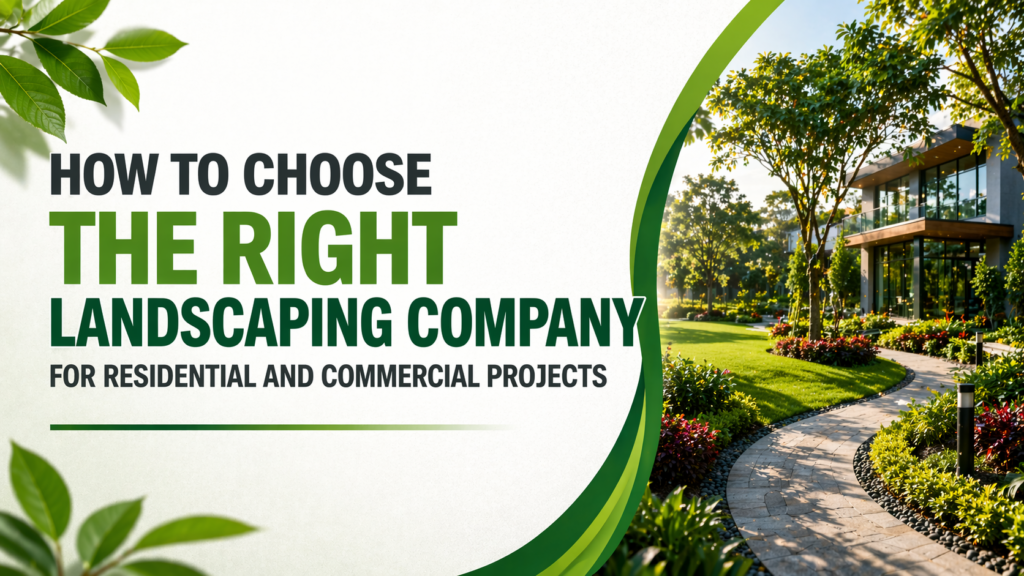
Your outdoor space tells a story before anyone steps through the front door. A welcoming garden path at a family home or a manicured entrance to a corporate campus — the quality of your landscape makes a lasting impression. The challenge, however, is knowing who to trust with it.
Choosing the right landscaping company is one of the most important decisions a property owner can make. Getting this decision wrong can cost you time, money, and the health of your outdoor environment.
This guide covers residential vs. commercial landscaping, how to evaluate contractors, compare quotes, and build lasting provider relationships.
Understanding the Scope: Residential vs. Commercial Landscaping
Before you begin searching, it helps to understand that residential landscaping and commercial landscaping are fundamentally different disciplines — even though many landscape services overlap between them.
Residential landscaping focuses on personal outdoor spaces: gardens, lawns, driveways, patios, planting beds, and backyard features. The work is intimate and design-led. Homeowners usually have strong personal preferences, and the best landscape contractors in this space are excellent listeners as much as skilled tradespeople. Projects might include garden redesign, lawn installation, irrigation systems, outdoor lighting, and seasonal planting schemes.
Commercial landscaping operates at a different scale and pace. Office parks, shopping centres, hotels, hospitals, and industrial estates all require professionally maintained grounds that project a specific brand image, meet accessibility requirements, and often comply with environmental regulations. A commercial landscaping company typically employs larger crews, uses industrial-grade equipment, works within strict scheduling windows, and provides account management alongside the physical work.
Knowing which category your project falls into helps you filter providers from the start. A company that excels at residential garden design may not have the crew size or equipment to handle a large commercial account — and vice versa.
Key Qualities to Look for in Any Landscaping Company
Regardless of whether your project is residential or commercial, certain qualities separate reliable landscape contractors from those best avoided.
Experience and Specialisation Years in business matter, but relevant experience matters more. Ask specifically about projects similar to yours. A landscaping company that has designed and maintained several hotel grounds will bring insights that a purely domestic provider simply cannot offer. Request case studies or a portfolio, and where possible, ask to visit a completed project in person.
Licensing, Insurance, and Certifications This is non-negotiable. A legitimate landscaping company should hold the appropriate trade licences required in your region, carry public liability insurance, and — for larger commercial projects — employer liability coverage. Certifications from recognised industry bodies (such as the British Association of Landscape Industries in the UK, or the National Association of Landscape Professionals in the US) indicate commitment to professional standards.
A Clear and Detailed Proposal Vague quotes are a warning sign. A reputable landscape contractor will provide a written proposal that breaks down the scope of work, materials to be used, project timeline, payment schedule, and what happens if unforeseen issues arise. This document protects both parties and forms the basis of your contract.
Communication and Responsiveness The way a company communicates during the quoting process tells you a great deal about how they will communicate once the work begins. Slow responses, vague answers, or reluctance to put things in writing are red flags. The right provider will be prompt, transparent, and genuinely interested in understanding your goals.
References and Reviews Ask for references from recent clients — ideally ones with similar project types. Online reviews on Google, Houzz, or industry-specific platforms provide additional perspective. Look for patterns in feedback rather than individual comments. Consistent praise for reliability and quality is more meaningful than a single glowing testimonial.
How to Evaluate a Landscaping Company for Residential Projects
Hiring for a residential landscaping project involves a personal dimension that commercial procurement typically does not. Your garden is an extension of your home. It should reflect your lifestyle, your preferences, and the way you want to use the space.
When evaluating landscape services for a residential property, start by clarifying your own vision. Do you want a low-maintenance garden? A space for children to play? An outdoor entertaining area? A kitchen garden? The more clearly you can articulate what you want, the easier it becomes to assess whether a potential provider genuinely understands your brief.
During initial consultations, pay attention to whether the landscaping company asks questions or simply presents a pre-packaged solution. Good residential landscape contractors invest time in understanding the orientation of your garden, the soil type, the microclimate, and how you actually use the outdoor space throughout the year. They will advise on plant choices appropriate to your conditions rather than specifying whatever happens to be readily available.
Also enquire about ongoing maintenance. Many homeowners commission a new garden design only to find it gradually deteriorating because the maintenance requirements were underestimated or no ongoing plan was put in place. The best residential landscaping companies offer structured maintenance programmes that keep your garden looking its best through every season.
Choosing a Landscaping Company for Commercial Projects
Commercial landscaping procurement is typically more formal and involves more stakeholders. If you are a facilities manager, property developer, or business owner, your selection process will likely involve tendering, comparing multiple bids, and reviewing contract terms carefully.
Several factors deserve particular attention in the commercial context.
Capacity and Crew Size A commercial landscaping company needs to demonstrate that it has sufficient resources to service your account reliably. Ask about crew sizes, equipment owned versus hired, and contingency arrangements for periods of staff absence or equipment failure. A contractor that cannot cover absences will leave your property looking neglected.
Health and Safety Credentials On a commercial site, health and safety compliance is a legal requirement, not just best practice. Ask to see the company’s health and safety policy, risk assessment procedures, and evidence of staff training. COSHH assessments for chemical applications (such as herbicides and fertilisers) are particularly important for sites where the public or employees are regularly present.
Account Management For larger commercial accounts, you should expect a named account manager — a single point of contact who knows your site, understands your expectations, and can be reached without being passed through a call centre. Strong account management separates professional landscape contractors from transactional providers.
Sustainability Practices Increasingly, commercial clients are asking their landscaping companies to align with environmental and sustainability commitments. This might include reduced pesticide use, water-efficient irrigation design, native planting schemes that support biodiversity, responsible waste disposal, and fleet vehicles with lower emissions. If sustainability is important to your organisation, make it an explicit requirement in your brief.
Questions to Ask Before Signing Any Contract
Armed with the above criteria, here are the specific questions to put to any landscaping company before committing to a contract:
- How long have you been providing landscape services of this type, and can you share relevant examples?
- Are you fully licensed, insured, and a member of any recognised industry associations?
- Who will be on site day-to-day, and will there be a consistent team or rotating crews?
- How do you handle non-standard situations — plant failures, unexpected drainage issues, or weather delays?
- What does your quality control process look like, and how do you measure client satisfaction?
- Can you provide three references from clients with similar projects completed in the last 12 months?
- What are your payment terms, and what is the process if either party needs to make changes to the agreed scope?
The answers to these questions — and the confidence and transparency with which they are given — will tell you a great deal about whether a landscaping company is genuinely the right fit.
Red Flags to Watch Out For
Even with thorough research, it is worth knowing what to avoid. The following are warning signs that should cause you to pause before proceeding with a landscaping company.
Unusually Low Quotes If one quote is significantly cheaper than all others, ask why. Low pricing sometimes reflects the use of inferior materials, unlicensed labour, or a plan to cut corners on site. Price competition is healthy, but a quote that seems too good to be true usually is.
No Written Contract Any landscaping company that resists putting the agreement in writing is operating in a way that protects only themselves. A signed contract is your primary protection if things go wrong.
Pressure to Pay Large Deposits Upfront A reasonable deposit is standard practice, but a demand for 50% or more of the project cost upfront — particularly from a company you have no prior relationship with — is a risk. Established landscape contractors with solid cash flow do not typically need large advance payments to purchase materials.
Lack of Portfolio or References A company that cannot show you completed work or connect you with satisfied past clients has either no track record or reasons for not sharing one. Neither is acceptable.
Building a Long-Term Relationship with Your Landscape Contractor
The best outcomes in landscaping come from long-term relationships. A provider who has worked with you through multiple seasons understands your property intimately — they know which areas drain poorly, which plants thrive, and how you like the space prepared for different times of year.
For residential clients, this means viewing your landscaping company not just as a service provider but as a steward of your outdoor environment. Regular communication, an annual review of the maintenance programme, and genuine feedback about what is and is not working will help your contractor serve you better over time.
For commercial clients, a long-term contractual relationship with a trusted landscape services provider reduces procurement costs, ensures continuity of care, and makes it easier to plan capital improvements to the grounds over a multi-year horizon.
In both cases, loyalty to a high-performing contractor is typically rewarded with better service, greater responsiveness, and often more competitive pricing at contract renewal.
The Cost of Getting It Wrong
It is worth reflecting briefly on what poor landscaping decisions actually cost. Beyond the obvious aesthetic disappointment, hiring the wrong landscaping company can result in:
- Wasted investment in plants, materials, or hardscaping that fails prematurely due to poor installation or unsuitable specification
- Structural damage from incorrectly installed drainage, retaining walls, or tree roots interfering with foundations
- Regulatory issues for commercial properties where poorly maintained grounds create liability or violate planning conditions
- Reputational damage for businesses where the appearance of the exterior space directly influences customer or client perception
These costs are rarely visible upfront. They accumulate over months and years, long after the original contractor has moved on. Choosing the right landscaping company from the outset is therefore an investment, not just a procurement exercise.
Conclusion
Choosing the right landscaping company requires more than a quick internet search and the lowest quote. It demands careful evaluation of experience, credentials, communication, and genuine fit for your specific project — whether residential or commercial.
Take your time. Ask the right questions. Check references. And when you find a landscaping company that meets your standards, invest in building a long-term relationship.
Frequently Asked Questions
FAQ 1: How do I find a reliable landscaping company near me?
Start by asking neighbours, friends, or colleagues for personal recommendations — word-of-mouth referrals for landscape contractors are often the most reliable source. Supplement this with online searches, checking Google reviews, and looking at platforms like Houzz or Checkatrade. Verify that any company you shortlist is licensed, insured, and can provide references from recent, relevant projects.
FAQ 2: What is the difference between residential and commercial landscaping?
Residential landscaping focuses on personal garden spaces and is typically design-led, working closely with homeowners to reflect their individual preferences and lifestyle. Commercial landscaping operates at a larger scale, maintaining grounds for businesses, institutions, and developments. Commercial landscape services involve larger crews, industrial equipment, formal account management, and compliance with health, safety, and environmental regulations.
FAQ 3: How much does a landscaping company typically charge?
Costs vary widely depending on the scope of work, location, and the type of landscape services required. Residential garden redesigns might range from a few hundred to several thousand pounds or dollars. Ongoing commercial maintenance contracts are typically priced monthly or annually based on site size and service frequency. Always obtain at least three written quotes to understand the market rate for your specific project.
FAQ 4: Can a single landscaping company handle both design and ongoing maintenance?
Many full-service landscaping companies offer both design and installation alongside ongoing maintenance programmes. This can be advantageous because the same team that designed and planted your space understands it best. However, it is worth confirming at the outset whether maintenance is genuinely part of their core offering or an add-on that receives less attention than new installation work.